
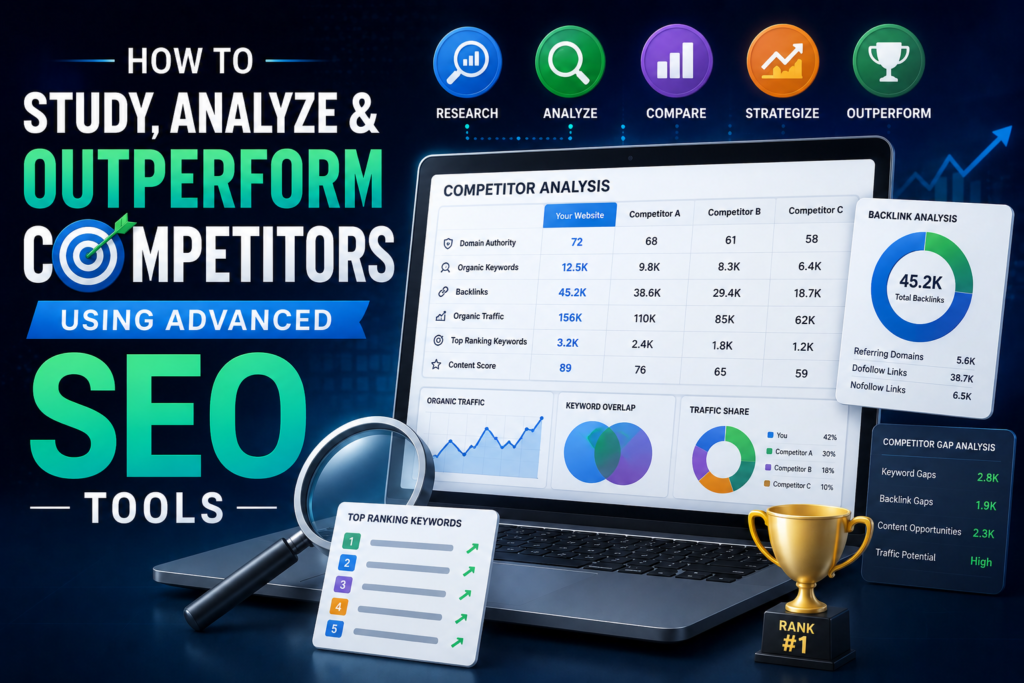
In today’s competitive digital space, ranking on the first page of Google isn’t just about optimizing your own website — it’s about understanding what your competitors are doing better.
As a digital marketing expert, competitor analysis is not optional — it’s strategic intelligence. When done correctly, it reveals keyword gaps, backlink opportunities, content weaknesses, and untapped ranking potential.
Here’s how to systematically study, analyze, and outperform competitors using advanced SEO tools.
Step 1: Identify Your Real SEO Competitors
Your business competitors and your SEO competitors may not be the same.
Search your primary keywords on Google and analyze:
- Who ranks in the top 10?
- Are they blogs, service pages, marketplaces, or local businesses?
- What type of content is dominating?
These are the websites you need to study — not just the businesses you compete with offline.
Step 2: Perform Keyword Gap Analysis
Keyword gap analysis helps you find:
- Keywords your competitors rank for
- Keywords you don’t rank for
- Low-competition opportunities
Tools like:
- SEMrush
- Ahrefs
- Ubersuggest
allow you to compare domains and uncover hidden ranking opportunities.
What to Look For:
✔ High-volume keywords
✔ Long-tail keywords with lower competition
✔ Commercial intent keywords
✔ Content topics bringing them traffic
Action Strategy:
Create better, deeper, and more optimized content targeting those keyword gaps.
Step 3: Analyze Competitor Backlink Profiles
Backlinks remain one of the strongest ranking signals.
Use tools like:
- Ahrefs
- Moz Pro
to analyze:
- Where competitors get backlinks from
- The quality of referring domains
- Anchor text distribution
- Guest posting opportunities
Outperform Strategy:
Instead of copying backlinks, improve on them:
- Reach out to higher-authority sites
- Create better resources worth linking to
- Build digital PR campaigns
Step 4: Study Their Content Strategy
Look at:
- Blog frequency
- Content length
- Use of visuals
- Internal linking structure
- Content depth
Ask:
- Are they answering user intent fully?
- Is their content outdated?
- Can you create something more comprehensive?
Winning in SEO is not about copying — it’s about creating superior value.
Step 5: Audit Technical SEO Performance
Sometimes competitors rank higher because of technical advantages.
Use tools like:
- Screaming Frog SEO Spider
- Google Search Console
Analyze:
- Site speed
- Mobile optimization
- Crawl errors
- Indexing issues
- Core Web Vitals
Improving technical SEO can quickly boost your ranking potential.
Step 6: Evaluate Their User Experience & Conversion Strategy
SEO isn’t just about traffic — it’s about conversion.
Study:
- Page layout
- Call-to-action placement
- Landing page structure
- Trust signals (reviews, testimonials)
If your competitor ranks high but converts poorly, that’s your opportunity to dominate both rankings and revenue.
Step 7: Turn Data Into Strategic Execution
As a digital marketing expert, data without action is useless.
Your execution plan should include:
✔ Creating better optimized content
✔ Strengthening internal linking
✔ Improving technical SEO
✔ Building high-authority backlinks
✔ Targeting missed commercial keywords
Consistency is what separates analysis from dominance.
Common Mistakes to Avoid
❌ Copying competitors blindly
❌ Targeting overly competitive keywords immediately
❌ Ignoring search intent
❌ Focusing only on traffic, not conversions
Smart competitor analysis is about finding gaps — not imitation.
Final Thoughts
SEO success is rarely accidental. It’s strategic.
By leveraging advanced SEO tools and data-driven analysis, you can:
- Identify ranking opportunities
- Discover content gaps
- Build stronger authority
- And consistently outrank competitors
In a competitive market, those who analyze deeply and execute strategically always win.